
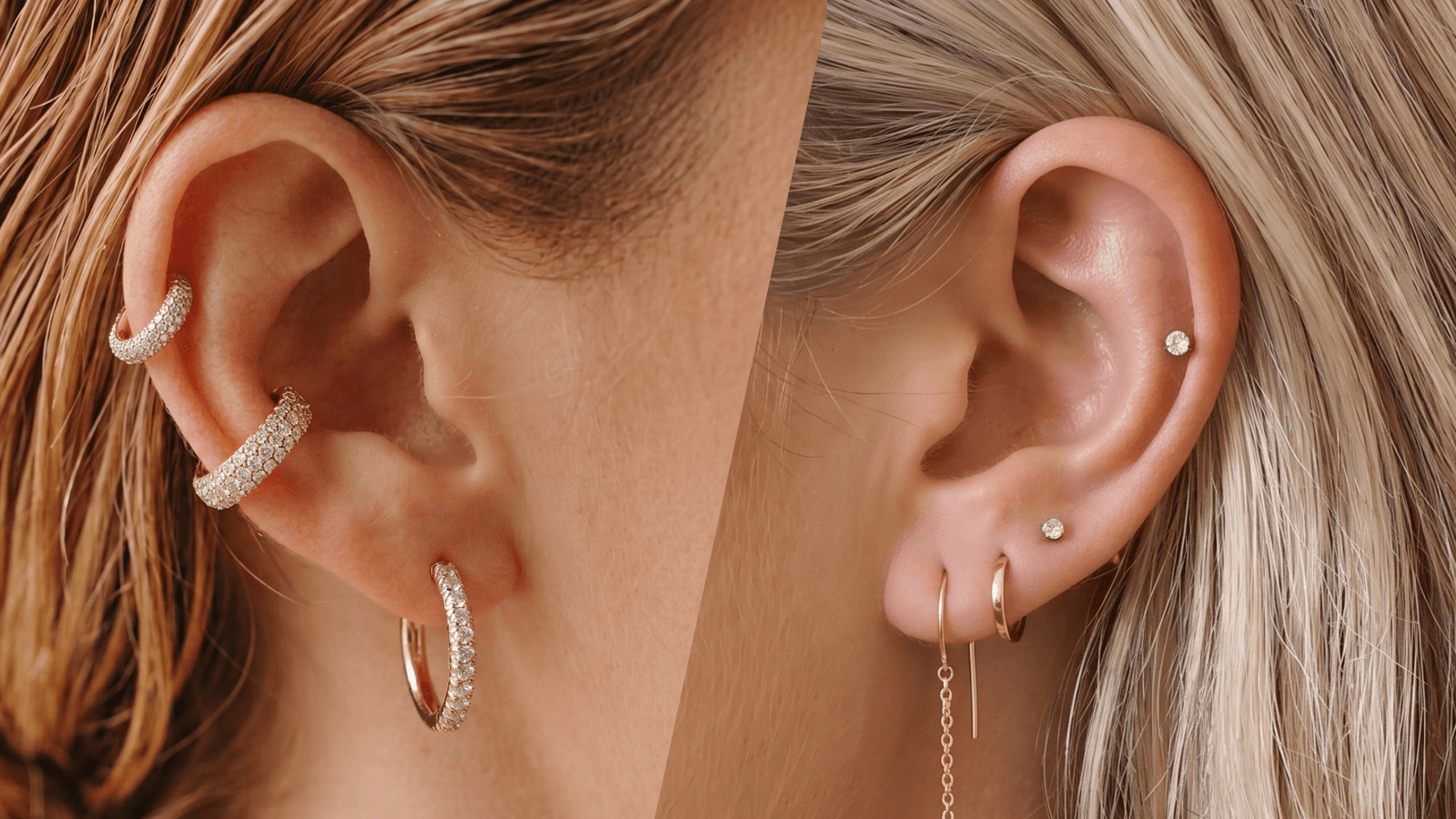
A mid-helix piercing sits along the outer cartilage of the ear, usually between the upper helix and the lower cartilage curve. It is subtle, modern, and easy to style, which makes it one of the most versatile placements for anyone building a curated ear.
Unlike a standard lobe piercing, a mid-helix piercing adds shape and structure to the ear without feeling too bold. It can work beautifully as a single detail, or it can become part of a larger ear stack with lobes, upper helix piercings, flat piercings, or conch jewelry.
This guide explains where a mid-helix piercing is placed, how it heals, which jewelry styles are commonly used, and how to style it with a clean, balanced look.
What Is a Mid-Helix Piercing?
A mid-helix piercing is a cartilage piercing placed on the middle section of the outer ear rim. It is not as high as a traditional upper helix and not as low as some lower cartilage piercings. This middle placement gives it a balanced appearance and makes it easy to combine with other ear piercings.
The exact position can vary depending on ear anatomy. Some ears have a more defined outer rim, while others have a softer curve. A professional piercer can help choose a placement that follows the natural shape of the ear and leaves enough space for future piercings.
Mid-Helix vs. Helix Piercing: What’s the Difference?
A helix piercing usually refers to any piercing along the outer cartilage rim of the ear. A mid-helix is a more specific version of that placement.
The difference is mainly location.
A traditional helix is often placed higher on the upper ear. A mid-helix sits slightly lower, closer to the center of the outer cartilage. This makes it feel more subtle and easier to blend into a minimal ear stack.
For someone who wants a cartilage piercing that feels stylish but not too dramatic, the mid-helix can be a strong choice.
Is a Mid-Helix Piercing Good for a First Cartilage Piercing?
A mid-helix piercing can be a good first cartilage piercing for many people, but it depends on comfort level, lifestyle, and ear anatomy.
Because it sits on the outer ear, it is visible and easy to style. However, like other cartilage piercings, it usually requires more patience than a lobe piercing. Cartilage piercings can take several months to fully heal, and Cleveland Clinic notes that cartilage piercings such as helix, tragus, rook, daith, and conch piercings may take around six to twelve months to heal fully.
If you sleep on that side, wear headphones often, or frequently change jewelry, healing may feel more challenging. A simple, well-fitted starter piece is usually easier to manage during the early healing stage.
Mid-Helix Piercing Pain Level
Pain is personal, so there is no exact number that applies to everyone. In general, a mid-helix piercing may feel sharper than a lobe piercing because it goes through cartilage rather than soft tissue.
Most people describe the sensation as quick pressure followed by a brief pinch. The piercing itself is usually fast, but the area may feel tender afterward, especially if it is touched, bumped, or slept on.
The most important part is not only the piercing moment, but the healing period that follows. Cartilage piercings need gentle care and time.
Healing Basics for a Mid-Helix Piercing
A mid-helix piercing usually heals more slowly than a lobe piercing because cartilage has less blood flow than soft tissue. This slower healing process means the piercing can look fine on the outside before it is fully settled inside.
General healing tips include:
Clean the piercing only as recommended by your piercer.
Avoid twisting or moving the jewelry.
Do not sleep directly on the piercing.
Keep hair, headphones, and hats from catching on the jewelry.
Avoid changing jewelry too early.
Be careful when brushing hair or removing clothing.
If there is unusual swelling, strong pain, heat, or discharge, it is better to speak with a professional piercer or healthcare provider instead of trying to solve it yourself.
Best Jewelry Styles for a Mid-Helix Piercing
The best jewelry for a mid-helix piercing depends on whether the piercing is new or fully healed.
For a fresh mid-helix piercing, a small flat back stud is often a practical option because it sits close to the ear and moves less than a hoop. Less movement can make the healing process feel more comfortable.
Once healed, the styling options become more flexible. Popular choices include:
Tiny gold studs
Minimal ball studs
Small gemstone studs
Delicate flat back designs
Slim cartilage hoops
Tiny huggie hoops
14K gold is a popular choice for a refined cartilage look because it feels polished, minimal, and suitable for long-term styling. For a mid-helix piercing, small proportions often work best because the placement is naturally subtle.
Can You Wear a Hoop in a Mid-Helix Piercing?
Yes, a hoop can look beautiful in a mid-helix piercing, but timing matters. A hoop usually moves more than a stud, so many piercers recommend starting with a stud and switching to a hoop only after the piercing is fully healed.
A small, fitted hoop can create a clean line along the outer ear. It works especially well when paired with tiny lobe studs or a second cartilage piercing. The key is balance. If the hoop is too large, it may overpower the placement or catch more easily.
How to Style a Mid-Helix Piercing
The mid-helix is one of the easiest cartilage placements to style because it sits in the center of the ear’s outer curve. It can connect the lower lobe area with upper cartilage piercings, creating a smooth visual flow.
For a minimal look, pair a tiny 14K gold stud in the mid-helix with simple lobe earrings. This keeps the ear clean and refined.
For a curated ear, combine the mid-helix with a second lobe, upper helix, or flat piercing. Use different sizes rather than too many similar pieces. A small stud in the mid-helix, a tiny hoop in the helix, and a simple lobe earring can create a balanced stack.
For a softer look, choose round shapes, tiny gems, or delicate gold details. For a more defined style, choose geometric studs or a slim hoop.
Common Styling Mistakes to Avoid
One common mistake is choosing jewelry that is too large for the placement. The mid-helix is naturally subtle, so oversized pieces may feel heavy or visually crowded.
Another mistake is mixing too many statement pieces on the same ear. If every piercing is bold, the ear stack can lose its shape. A better approach is to choose one focal point and keep the other pieces smaller.
Changing jewelry too soon is also a common issue. Even if the piercing looks healed, the inside may still be sensitive. Waiting until the piercing is fully healed can help avoid irritation.
Who Is a Mid-Helix Piercing Best For?
A mid-helix piercing is ideal for someone who wants a cartilage piercing that feels stylish, wearable, and easy to combine with other placements.
It works well for:
Minimal ear stacks
Gold jewelry styling
First cartilage piercing ideas
Balanced curated ears
Subtle everyday looks
People who want a visible but not overly bold piercing
It is also a good choice for anyone planning future piercings because the placement leaves room above and below for more styling options.
Final Thoughts
A mid-helix piercing is a small detail with strong styling potential. Its middle placement makes it easy to wear alone or combine with other piercings, especially in a minimal or curated ear stack.
The best results come from thoughtful placement, simple starter jewelry, patient healing, and balanced styling. Whether worn with a tiny 14K gold stud or a slim hoop after healing, the mid-helix piercing offers a modern way to shape the ear with subtle detail.

Leave a Reply