

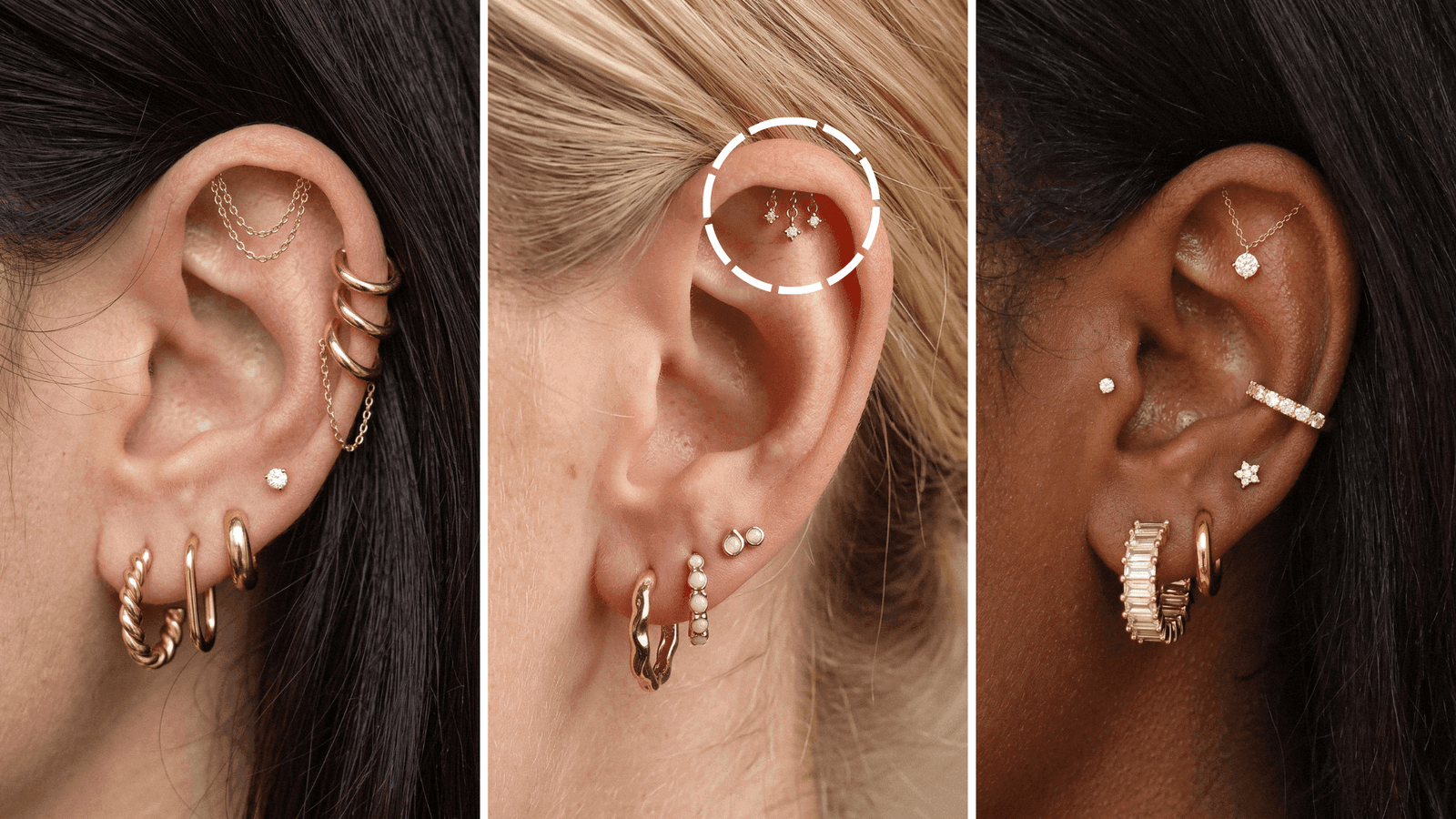
A hidden helix piercing is a cartilage piercing tucked under the fold of the upper ear rim, so the jewelry peeks out from behind the curl rather than sitting on top of it. From the front you see a small flash of metal or a stone; from the side you see how cleverly it hugs the ear’s natural shape.
That contrast is exactly why it has become a favorite for people building a curated ear. It looks intentional without looking crowded, it works with almost any existing stack, and it suits both minimalist and maximalist styles.
In this guide, we cover where a hidden helix sits, whether your anatomy suits it, the best jewelry options, styling ideas you can copy, and what healing realistically looks like.
Hidden Helix Piercing Placement
The hidden helix sits on the underside of the helix, the curled outer rim of your upper ear. Instead of piercing straight through the visible edge, the piercer places the jewelry so it nestles inside the fold. The decorative end appears to tuck under the rim, which creates that “now you see it, now you don’t” effect.
If you are still mapping out your ear, think about how the hidden helix will sit alongside your lobe, conch, and rook placements before you book.
Is Your Anatomy a Good Fit?
This piercing depends heavily on ear shape. It works best when the helix has a pronounced, rolled fold with enough cartilage underneath to support the jewelry.
- Good candidates: a deep, defined rim curl that creates a visible shelf.
- Harder candidates: a flat or shallow rim with little or no fold.
- The deciding factor: an in-person anatomy check by an experienced piercer.
If your rim is too shallow, a reputable piercer will suggest an alternative instead of forcing the placement.
Single Hidden Helix
One hidden helix on the upper rim is the classic version. It works as a quiet focal point and pairs well with a simple lobe stack below.
Double or Stacked Hidden Helix
Two hidden helix piercings placed one above the other along the fold create a subtle line of sparkle. This option needs enough fold length, so it is not possible on every ear.
Hidden Helix vs. Standard Helix
| Feature | Hidden helix | Standard helix |
|---|---|---|
| Position | Underside of the rim fold | Through the outer rim edge |
| Visibility | Peeks out from under the fold | Fully visible from the front |
| Anatomy needs | A pronounced fold is essential | Works on most ears |
| Typical jewelry | Flat-back stud with a small top | Stud first, hoop after healing |
Want something more visible on the rim? Read our mid-helix piercing guide for a classic alternative.
Hidden Helix Jewelry Options
The best starter jewelry for a hidden helix is a flat-back labret stud with a small, low-profile top. The flat disc sits comfortably against the back of the cartilage, and a compact top tucks neatly under the fold without catching on hair.
Flat-Back Labret Studs
This is the go-to choice for initial jewelry. Threadless or internally threaded labrets let you swap tops later without changing the post. Popular tops include:
- Tiny bezel-set gems for a soft sparkle under the rim
- Polished gold or titanium balls and discs for a minimalist look
- Small clusters or marquise shapes for a more decorative finish
Curved Barbells
Some piercers use a small curved barbell that follows the fold’s natural curve. It is less common, but it can suit certain anatomies. Ask your piercer which style matches your ear.
Hoops (After Healing Only)
Hoops are usually not recommended for a fresh hidden helix because they move more and can irritate the channel. Once fully healed, a snug seamless ring or clicker can look striking curving out from under the fold. Our hoop size guide explains how to choose a diameter that hugs the ear.
Sizing Basics
Most hidden helix piercings are done at 16G or 18G. Your first post is usually slightly longer to allow for swelling, then downsized to a snug fit once swelling settles.
Best Materials
- Implant-grade titanium (ASTM F136): lightweight, nickel-free, and ideal for fresh piercings
- Solid 14K or 18K gold: nickel-free and body-safe for initial or healed wear
- Niobium: a hypoallergenic option that comes in colorful anodized finishes
Avoid plated, mystery-metal, or sterling silver jewelry in a healing cartilage piercing. Silver can tarnish and irritate fresh tissue.
Hidden Helix Styling Ideas
The hidden helix shines when it plays a supporting role in a wider ear story. Here are five looks to try.
Try This Look: The Peekaboo Sparkle
Pair a single hidden helix with a tiny clear or opal gem and two simple lobe studs. The stone catches the light only when you move, which keeps the overall look soft and understated. It is a perfect starting point for a minimalist ear stack.
Try This Look: Warm Gold Curation
Combine a polished 14K gold hidden helix with a vertical stacked lobe and a small gold hoop in the second lobe. Keeping every piece in the same metal tone makes the stack feel cohesive.
Try This Look: Upper Ear Constellation
Add a hidden helix to a cluster of flat piercings for a scattered, starry effect. The hidden helix acts as the outer edge of the constellation and frames the design.
Try This Look: Double Hidden Helix Line
Two matching hidden helix studs along the fold create a delicate line of metal. Choose identical small balls or bezels so the eye reads them as one design element.
Try This Look: The Cartilage Trio
Pair a hidden helix with a tash rook and a mid-helix for a fuller upper-ear project. Mix one statement top with two quieter pieces to avoid visual clutter.
Styling tip: Plan your stack before you book. Space between piercings matters, and a piercer can mark several options so you can see the balance before committing.
Pain, Healing, and Aftercare
A hidden helix typically takes 6 to 12 months to heal fully, like most cartilage piercings. Pain is usually described as moderate: a sharp pinch during the piercing, followed by tenderness for a few days.
Healing Timeline
| Stage | Typical timing | What to expect |
|---|---|---|
| Fresh | Weeks 1–2 | Swelling, tenderness, and mild redness |
| Settling | Weeks 4–12 | Swelling eases; ask about downsizing your post |
| Strengthening | Months 3–6 | Looks healed outside but is still fragile inside |
| Fully healed | Months 6–12 | Safe to change jewelry and consider hoops |
Every body heals at its own pace, so treat these stages as a guide rather than a deadline.
Aftercare Essentials
- Rinse with sterile saline spray once or twice a day.
- Dry gently with a clean paper towel instead of cloth towels.
- Avoid twisting, touching, or removing the jewelry while healing.
- Downsize your post when your piercer recommends it.
- Keep hair products, phones, and headphones away from the area.
Sleeping and Daily Life
Pressure is a common source of irritation for upper-ear cartilage. A travel pillow or sleeping on the opposite side can help, as covered in our guide to sleeping with helix, conch, and tragus piercings. In winter, cold wind can make cartilage ache, so keep the ear covered when you head outside.
Watch for Bumps
Irritation bumps are common with cartilage piercings and are usually linked to pressure, movement, or jewelry that is too long. Downsizing and gentle, consistent aftercare often help. If you notice spreading redness, heat, or discharge, see a medical professional.
Hidden Helix Piercing FAQ
What is a hidden helix piercing?
It is a cartilage piercing placed on the underside of the upper ear’s rim fold. The jewelry tucks under the curl, so only a small part of it shows from the front.
Does a hidden helix hurt more than a regular helix?
Most people find the pain similar to other upper-ear cartilage piercings. The placement can feel more awkward because it sits under the fold, but the sensation is brief.
Can anyone get a hidden helix?
Not everyone. You need a pronounced helix fold with enough cartilage beneath it. A professional piercer can tell you in a quick anatomy check.
How long does a hidden helix take to heal?
Expect roughly 6 to 12 months for full healing. It can look healed well before the inside of the channel is stable.
Can I wear a hoop in a hidden helix?
Yes, but only after it is fully healed. Studs are the safer choice during healing because they move less.
What gauge is a hidden helix?
It is usually pierced at 16G or 18G. Your piercer will choose based on your anatomy and the jewelry style.
Can I sleep on a new hidden helix?
It is best to avoid direct pressure while healing. Sleep on the other side or use a travel pillow to protect the ear.
Ready to Add a Hidden Helix to Your Ear?
The hidden helix is proof that the most memorable piercings are not always the loudest. Tucked under the rim, it adds depth, surprise, and a touch of sparkle to any ear project.
Start with an anatomy check at a reputable studio, choose implant-grade titanium or solid gold for your first piece, and give it the full healing time it deserves. Then have fun styling it.
Looking for more inspiration? Keep exploring PiercingMag for styling ideas and care tips to plan your next piercing.

Leave a Reply